A Comprehensive Guide to Indonesia’s Education System, Compulsory Education, and Key Challenges
Table of Contents
Indonesia’s education system, from early childhood (PAUD) to higher education (Pendidikan Tinggi), operates under a national curriculum. Compulsory education spans nine years (six years of elementary school and three years of junior high school), and the government is actively implementing reforms to improve access and quality. However, significant challenges remain, including regional disparities in education, inadequate school facilities, and the need for teacher quality improvement. This article provides a detailed overview of Indonesia’s education system, its characteristics, challenges, and government support initiatives.
Characteristics of Early Childhood Education (PAUD) in Indonesia
Indonesia’s early childhood education (Pendidikan Anak Usia Dini: PAUD) is a system for children aged 0-6, operated under the National Education System Law (Undang-Undang Sistem Pendidikan Nasional). Its primary goal is to promote early development and help children transition smoothly into elementary school.
1. Types of PAUD
PAUD is mainly categorized into three types:
① Childcare Centers (Taman Penitipan Anak: TPA)
Age Group : 0-2 years old
Purpose : To provide a safe environment for children while their parents are at work.
Features : Focuses on childcare with minimal educational elements. Aims to teach basic life habits and social skills.
② Playgroups (Kelompok Bermain: KB)
Age Group : 2-4 years old
Purpose : To nurture social skills through play.
Features : Encourages children’s curiosity through storytime, rhythm games, and simple physical activities.
③ Kindergarten (Taman Kanak-Kanak: TK)
Age Group : 4-6 years old
Purpose : To teach basic literacy and numeracy skills and improve communication abilities.
Features : Includes both public and private kindergartens, with many religious kindergartens (Islamic or Christian). Additionally, there are community-based Integrated PAUD (PAUD Terpadu) and informal home-based PAUD (PAUD Berbasis Keluarga).
2. PAUD Curriculum
① National Curriculum (Kurikulum PAUD 2013) While early childhood education is not officially mandatory, the Indonesian government recommends that kindergarten (TK) graduation be a prerequisite for elementary school enrollment. The curriculum emphasizes development in five key areas:
Religious and Moral Education (Pendidikan Agama dan Moral) : Includes religious education (Islam, Christianity, etc.).
Physical and Motor Development (Perkembangan Fisik-Motorik) : Develops fine motor skills through activities like drawing and origami.
Cognitive and Knowledge (Perkembangan Kognitif) : Teaches basic concepts of numbers and language.
Language Development (Perkembangan Bahasa) : Focuses on basic Indonesian conversation and vocabulary.
Social-Emotional Development (Perkembangan Sosial-Emosional) : Practices interaction with peers and emotional expression.
② Introduction of Local Curricula In some areas of Bali and Java, traditional culture (Balinese dance, shadow puppetry) is incorporated into PAUD activities. Some kindergartens in certain regions adopt bilingual education (Indonesian + English/Chinese/Arabic).
3. PAUD Management Models
Indonesia’s PAUD institutions are operated by both public and private entities:
① Public PAUD
Operated with government support, offering free or low-cost tuition.
Quality varies, and facilities and teaching materials may be insufficient.
② Private PAUD
Tuition ranges from Rp. 100,000 (approx. $6) to several million rupiah (tens of thousands of yen) per month.
There are also high-end kindergartens affiliated with international schools (e.g., Jakarta Intercultural School, Singapore Intercultural School), which offer a high level of education.
③ Islamic PAUD (Raudhatul Athfal: RA)
Kindergartens based on Islamic teachings.
Include Quran recitation (Tahfiz Al-Qur’an) and Islamic moral education.
4. Current Challenges and Issues with PAUD
① Disparity in Enrollment Rates
Enrollment rates are high in urban areas, but low in rural and remote regions due to a lack of PAUD facilities.
Families living in poverty may not be able to afford PAUD fees.
② Teacher Quality
Many PAUD teachers lack formal qualifications in early childhood education.
The government is strengthening teacher training programs, but more support is needed.
③ Lack of Facilities and Teaching Materials
Many kindergartens in rural areas lack classrooms and playground equipment.
While some schools receive government-subsidized teaching materials, the adoption of modern educational technology (tablets, smartboards) is still limited.
5. Government Support and Future Outlook
The Indonesian government aims to strengthen early childhood education as part of compulsory education and is implementing the following measures:
Promoting PAUD Access : Increasing financial support for PAUD in rural areas to ensure equal access.
Improving Teacher Quality : Expanding support for teacher certification and training programs.
Introducing Digital Education : Accelerating the use of tablets and online teaching materials in early childhood education as part of the “Merdeka Belajar (Freedom to Learn)” policy.
Characteristics of Elementary Education (Pendidikan Dasar) in Indonesia
Indonesia’s elementary education (Pendidikan Dasar) covers elementary school (Sekolah Dasar: SD) and junior high school (Sekolah Menengah Pertama: SMP), forming the compulsory education stage. The government is implementing various reforms to improve access and quality. The following section details the characteristics of Indonesia’s elementary education.
1. Overview of Elementary Education
Age Group : 6-15 years old
Compulsory Education : 9 years (6 years of elementary school + 3 years of junior high school)
Grade Levels : Grade 1 to Grade 9
Education System : 6-3-3-4 system (6 years of elementary school + 3 years of junior high school + 3 years of high school + 4 years of university)
In Indonesia, elementary and junior high schools are considered “Pendidikan Dasar (Basic Education)” and are defined as compulsory education by the Constitution (Undang-Undang Dasar 1945) and the National Education System Law.
2. Types of Elementary Education
① Public Schools (Sekolah Negeri)
Government-operated schools with generally free tuition.
Varying quality of facilities and education across regions.
Provide education based on the national curriculum (Kurikulum Merdeka).
② Private Schools (Sekolah Swasta)
Operated by individuals or foundations, with tuition fees.
Often have better facilities and higher-quality teachers than public schools.
Implement curricula based on national standards while incorporating unique educational approaches.
③ Islamic Schools (Madrasah)
Religious schools managed by the Ministry of Religious Affairs (Kementerian Agama).
“Madrasah Ibtidaiyah (MI)” corresponds to elementary school, and “Madrasah Tsanawiyah (MTs)” corresponds to junior high school.
In addition to general subjects, students learn Islamic doctrine and Arabic.
④ International Schools (Sekolah Internasional)
Established primarily for foreign nationals, using curricula like the International Baccalaureate (IB) or Cambridge.
Instruction is in English or another foreign language.
Indonesian children require special permission to enroll.
3. Elementary School (Sekolah Dasar: SD)
① Educational Goals
To acquire basic literacy, numeracy, and social skills.
To encourage students to learn independently and express their creativity.
② Subject Composition Based on the 2023 “Kurikulum Merdeka” (Freedom to Learn Curriculum), the main subjects are:
Indonesian Language (Bahasa Indonesia)
Mathematics (Matematika)
Science (Ilmu Pengetahuan Alam: IPA)
Social Studies (Ilmu Pengetahuan Sosial: IPS)
English (Bahasa Inggris, only in some schools)
Religion (Pendidikan Agama)
Civics (Pendidikan Pancasila dan Kewarganegaraan: PPKN)
Physical Education (Pendidikan Jasmani dan Olahraga: PJOK)
Arts and Culture (Seni Budaya)
Local Language and Culture (Muatan Lokal)
③ Class Schedule and Learning Environment
5-6 hours per day, 5-6 days per week (varies by region).
Some schools have adopted a “Full Day School” system, with classes from 7:00 AM to 3:00 PM.
Class sizes are typically 30-40 students, meaning a higher student-to-teacher ratio compared to Japan.
4. Challenges in Elementary Education
① Regional Disparities
Urban areas have better educational facilities and higher-quality teachers, while rural and remote regions have limited access to education.
In some areas, the elementary school enrollment rate does not reach 100%.
② Teacher Quality
Many teachers lack sufficient training, making quality improvement a key challenge.
The government is working to strengthen teacher certification and training.
③ Lack of Facilities
Schools in rural areas often have inadequate toilets, classrooms, and internet access.
The government is promoting the introduction of digital education.
④ Educational Freedom
The new “Merdeka Belajar (Freedom to Learn)” policy, introduced in 2021, allows students to experience more practical learning.
However, implementation varies by school, and some schools still rely on traditional rote learning.
5. Government Support and Future Outlook
① Strengthening Free Education
Since 2015, the “Kartu Indonesia Pintar (KIP)” program has provided financial assistance to children from low-income families.
② Promoting ICT Education
The Indonesian government is advancing the “Sekolah Digital (Digital School)” project, which uses digital teaching materials.
In cooperation with Google for Education, Chromebooks are being introduced to schools across the country.
③ Strengthening STEAM Education
The introduction of programming education and robotics is progressing, and some schools have adopted “active learning.”
Characteristics of Secondary Education (Pendidikan Menengah) in Indonesia
Indonesian secondary education (Pendidikan Menengah) is divided into lower secondary education (SMP: Sekolah Menengah Pertama) and upper secondary education (SMA/SMK: Sekolah Menengah Atas / Sekolah Menengah Kejuruan). Attendance at lower secondary school (SMP) is mandatory under the compulsory education (Wajib Belajar) policy, while upper secondary education (SMA/SMK) is not compulsory.
1. Overview of Secondary Education
Age Group : 12-18 years old
Compulsory Education : 9 years (6 years of elementary school + 3 years of junior high school)
Education System : 6-3-3-4 system (6 years elementary + 3 years junior high + 3 years high school + 4+ years university)
Grade Levels :
SMP (Junior High) : Grade 7 to Grade 9
SMA/SMK (Senior High/Vocational High) : Grade 10 to Grade 12
2. Types of Secondary Education
① Lower Secondary Education (SMP: Sekolah Menengah Pertama)
Attended after graduating from elementary school (SD) as part of compulsory education.
Focuses on solidifying foundational academic skills and preparing students for upper secondary education.
② Upper Secondary Education (SMA/SMK)
Not compulsory, but a crucial stage for university admission or vocational training.
(1) General High School (SMA: Sekolah Menengah Atas)
An educational institution for students aiming for university.
Students specialize in science, social studies, or language/literature tracks starting in Grade 10.
Core subjects include Mathematics, Indonesian Language, English, Science (Biology, Chemistry, Physics), Social Studies (Geography, History, Economics), Religion, and Civics.
(2) Vocational High School (SMK: Sekolah Menengah Kejuruan)
Schools focused on vocational training, equipping students with skills for immediate employment.
Offers specializations in fields such as Industry, Tourism, Agriculture, IT, Business, and Healthcare.
Strong industry partnerships, with an emphasis on internships and practical skill assessments.
3. Curriculum
Secondary education is based on the “Kurikulum Merdeka (Freedom to Learn Curriculum)” introduced in 2021, promoting more flexible and practical learning.
① Core Subjects for SMP (Junior High)
Indonesian Language (Bahasa Indonesia)
Mathematics (Matematika)
Science (Ilmu Pengetahuan Alam: IPA)
Social Studies (Ilmu Pengetahuan Sosial: IPS)
English (Bahasa Inggris)
Religion (Pendidikan Agama)
Civics (Pendidikan Pancasila dan Kewarganegaraan: PPKN)
Physical Education, Sports, and Health (Pendidikan Jasmani, Olahraga, dan Kesehatan: PJOK)
Arts and Culture (Seni Budaya)
Vocational Studies (Prakarya)
② Specialization Tracks for SMA (Senior High)
Students follow a common curriculum until Grade 10, then choose one of three specialization tracks in Grade 11:
IPA (Ilmu Pengetahuan Alam)
Science track (focus on Mathematics, Physics, Chemistry, Biology)
IPS (Ilmu Pengetahuan Sosial)
Social studies track (focus on History, Economics, Geography, Social Sciences)
Bahasa (Bahasa dan Sastra)
Language and literature track (focus on Indonesian, English, foreign languages, literature)
③ Specialization Programs for SMK (Vocational High)
SMKs offer specialized programs to acquire specific vocational skills:
The mandatory national exam “Ujian Nasional (UN)” was abolished in 2021.
Evaluation is now primarily based on the “Ujian Sekolah Berstandar Nasional (USBN)”, standardized school exams administered by individual schools.
② Graduation Requirements
Graduation is determined by school-administered exams (USBN) and overall academic performance.
SMK students must also pass a vocational competency test (Uji Kompetensi Keahlian: UKK).
5. Challenges in Secondary Education
① Regional Disparities
Significant differences in facilities and educational standards between urban and rural schools.
Particularly in remote islands and rural areas, there are problems with teacher shortages and inadequate teaching materials.
② Challenges in Vocational Education (SMK)
Low employment rates for SMK graduates.
Insufficient industry collaboration, leading to some programs not aligning with actual industry needs.
③ Lag in Digital Education
Although the “Sekolah Digital (Digital School)” initiative is progressing, there are large disparities in ICT infrastructure between schools.
Digital education cannot be implemented in areas lacking internet access.
6. Government Reforms and Future Outlook
① Expansion of the Kurikulum Merdeka (Freedom to Learn Curriculum)
Promotes more practical and flexible learning, allowing schools to develop their own curricula.
In SMA, “project-based learning” has been introduced to promote learning relevant to real-world applications.
② Strengthening Digital Education
The government is promoting the “Sekolah Digital (Digital School)” concept, enhancing learning through the use of the internet and tablets.
Chromebook adoption is progressing through partnerships with Google for Education.
③ Improving Vocational Education
Strengthening collaboration between companies and SMKs to provide more practical vocational training.
Aiming to produce job-ready graduates by making internships mandatory.
Characteristics of Higher Education (Pendidikan Tinggi) in Indonesia
Higher education (Pendidikan Tinggi) in Indonesia is provided by institutions such as universities (Universitas), polytechnics (Politeknik), institutes (Institut), and academies (Sekolah Tinggi). It is not compulsory and operates under the National Education System Law (Undang-Undang Sistem Pendidikan Nasional).
1. Overview of Higher Education
Age Group : 18 years and older
Education System : 6-3-3-4 system (6 years elementary + 3 years junior high + 3 years high school + 4+ years university)
Degree Structure :
Diploma (D1-D4) : 1-4 years (vocational education)
Bachelor’s (Sarjana/S1) : 4 years
Master’s (Magister/S2) : 2 years
Doctorate (Doktor/S3) : 3+ years
2. Types of Higher Education Institutions
① Universities (Universitas)
The most common type of higher education institution, offering diverse faculties in humanities, sciences, engineering, and medicine.
Examples:
State : Universitas Indonesia (UI), Institut Teknologi Bandung (ITB), Universitas Gadjah Mada (UGM)
Private : Universitas Bina Nusantara (BINUS), Universitas Pelita Harapan (UPH)
② Institutes of Technology (Institut Teknologi)
Universities specializing in science, technology, and engineering.
Examples: Institut Teknologi Bandung (ITB), Institut Teknologi Sepuluh Nopember (ITS)
③ Polytechnics (Politeknik)
Higher education institutions focused on practical vocational training.
Offer D3 (3-year) and D4 (4-year) vocational degrees.
④ Institutes (Institut)
Institutions specializing in a specific field (e.g., education, arts, agriculture).
Example: Institut Seni Indonesia (ISI, Indonesia Institute of the Arts)
⑤ Academies (Sekolah Tinggi)
Single-discipline institutions focused on one specific field.
Example: Sekolah Tinggi Ilmu Ekonomi (STIE, Academy of Economic Sciences)
3. Higher Education Curriculum
① Bachelor’s Programs (Sarjana/S1)
Requires 4 years of study (144+ credits).
Compulsory Courses (Mata Kuliah Wajib) :
Pancasila (State Philosophy)
Indonesian Language (Bahasa Indonesia)
English (Bahasa Inggris)
Religion (Pendidikan Agama)
Statistics, Thesis Writing
Graduation Requirement : Submission of a thesis (Skripsi).
② Master’s Programs (Magister/S2)
Requires 2 years of study (36+ credits).
Focused on specialized research, requiring a master’s thesis (Tesis).
③ Doctoral Programs (Doktor/S3)
Requires 3+ years of research (42+ credits).
Submission of a doctoral dissertation (Disertasi) is mandatory.
4. University Admission System
Indonesian university admissions are primarily conducted through three methods:
① SNBP (Seleksi Nasional Berdasarkan Prestasi)
National selection based on high school academic records for state universities.
Only for top-performing students.
② SNBT (Seleksi Nasional Berdasarkan Tes)
A national computer-based written test (UTBK: Ujian Tulis Berbasis Komputer).
Includes tests in Mathematics, Indonesian Language, English, and Science.
③ Independent Admission (Ujian Mandiri)
Exams conducted independently by each university.
Used by private universities and some state universities.
Scholarships are provided by the government, private organizations, and international institutions.
Kartu Indonesia Pintar (KIP-K)
Indonesian Government
Students from low-income families
LPDP (Lembaga Pengelola Dana Pendidikan)
Government
Graduate students (domestic & overseas)
Erasmus Mundus, Fulbright, MEXT
EU, USA, Japan
Overseas study
6. Challenges in Higher Education
① Quality Disparities
State universities generally have higher quality, but there is significant variation among private universities.
In regional universities, facilities and faculty quality are lower compared to those in urban areas.
② Lack of Industry-Academia Collaboration
University curricula often do not align with industry needs, affecting graduate employability.
Graduates lack practical skills and are not immediately job-ready.
③ Low University Enrollment Rate
The enrollment rate is about 40%, lower than Japan’s 60-70%.
Many students from low-income families forgo university due to financial constraints.
④ Lag in Research and Technology Development
Indonesian universities’ research standards are internationally behind, with a low number of publications.
The government is increasing investment in AI and technology, but it is still developing.
7. Government Reforms and Future Outlook
① Promoting Digital Education
The “Merdeka Belajar Kampus Merdeka” policy increases opportunities for students to study at companies or foreign universities.
Adoption of online learning (MOOC) is advancing.
② Strengthening Industry-Academia Collaboration
Promoting mandatory internships and joint research with companies.
Enhancing partnerships between universities and companies in the industrial and digital sectors.
③ International University Collaboration
Increasing double degree programs.
Allowing foreign universities to establish campuses in Indonesia to promote educational internationalization.
Indonesia’s Education Quality and Challenges: A Detailed Analysis of Regional Disparities
While Indonesia’s education system has improved significantly in recent years, regional disparities (kesenjangan pendidikan) remain a serious issue. There is a vast difference in education quality, school infrastructure, teacher competence, and internet access between urban areas like Jakarta and Bali, and remote regions such as Papua, Sulawesi, and Kalimantan.
1. Current State of Educational Quality Disparities
① Educational Environment: Urban vs. Remote Areas
School Facilities
Latest IT equipment, projectors, air-conditioned classrooms
Lack of desks and chairs, dilapidated buildings, unstable electricity and water supply
Teacher Quality
Mostly university graduates with frequent training opportunities
Many unqualified teachers, insufficient training
Learning Materials
Digital materials and up-to-date textbooks available
Textbook shortages, use of outdated materials
Internet Environment
Wi-Fi available, online learning possible
Internet access is inadequate, online learning is impossible
Enrollment Rate (High School & University)
High school: >90%, University: >50%
High school: <60%, University: <20%
In urban areas, government support and private investment enable relatively high-quality education. In contrast, remote areas suffer from a shortage of schools, a lack of teachers, and poor learning environments.
2. Disparities in Teacher Quality
① Teacher Shortages and Qualification Issues
In urban public and private schools, teachers are often university graduates.
In remote areas, many teachers lack formal qualifications or have not studied education.
In some regions, due to severe teacher shortages, recent high school graduates are hired as teachers.
② Teacher Salaries and Benefits
Average Monthly Salary
Rp. 4,000,000 – Rp. 10,000,000 (~$260 – $650)
Rp. 2,000,000 – Rp. 4,000,000 (~$130 – $260)
Training Opportunities
Multiple sessions per year, including overseas training
Few to no training opportunities, slow updates on educational methods
Due to low salaries and difficult living conditions, teachers in remote areas often take on side jobs, which prevents them from focusing fully on their teaching.
3. Disparities in School Facilities and Infrastructure
① Physical School Environment
Urban Areas : Modern buildings, air-conditioned classrooms, equipped with digital whiteboards.
Remote Areas : Dilapidated buildings, wooden classrooms, shortages of desks and chairs.
② Internet and Digital Education
Urban Schools : High-speed internet, utilize Google Classroom and Zoom.
The government is promoting the “Sekolah Digital (Digital School)” initiative, but infrastructure development in remote areas is lagging, widening the gap with urban areas.
4. Differences in Learning Outcomes
① Results of the National Computer-Based Assessment (ANBK)
Schools in urban areas like Jakarta, Bandung, and Surabaya score above the national average.
Schools in remote areas like Papua, Maluku, and Sumbawa score more than 30% below the national average.
② Enrollment Rate Disparities
Jakarta, Bali, Surabaya
98%
90%
50%
Kalimantan, Sulawesi
85%
70%
30%
Papua, Maluku, Nusa Tenggara
70%
50%
20%
Many children in remote areas do not progress to high school after completing elementary school, primarily due to financial constraints and the long distance to schools.
5. Government Initiatives to Address Regional Disparities
① “Merdeka Belajar (Freedom to Learn)” Policy
Introduces flexible curricula tailored to regional needs.
Enables schools in remote areas to implement education based on local culture and industries.
② Kartu Indonesia Pintar (KIP) Scholarship Program
Supports children from low-income families to attend high school and university.
As of 2023, approximately 2 million students are receiving KIP support.
③ Frontline Teacher (Guru Garis Depan: GGD) Program
A project to send excellent teachers to remote area schools.
However, many teachers prefer to live in urban areas and avoid being dispatched to remote regions.
④ Promotion of Digital Education
Strengthening online learning environments through partnerships with Google for Education and Microsoft.
Ongoing projects to provide Chromebooks and internet equipment to schools on remote islands.
6. Future Challenges in Bridging the Gap
Teacher Shortage in Remote Areas
Increase salaries, strengthen teacher training programs in remote regions
Lag in Digital Education
Invest in infrastructure, expand internet access to remote areas
Aging School Facilities
Advance school construction and renovation through government-private sector collaboration
Students Dropping Out Due to Financial Reasons
Expand the KIP scholarship program, strengthen commuting support
Indonesia’s Education Quality and Challenges: A Detailed Analysis of Education Budget and Corruption
Indonesia’s government invests heavily in education to improve quality, but the management of this budget faces significant challenges. Inappropriate allocation and corruption (korupsi dalam pendidikan) exacerbate the educational gap between urban and rural areas and undermine education quality.
1. Overview of Indonesia’s Education Budget
The Indonesian government is constitutionally mandated (Article 31) to allocate 20% of the national budget (APBN: Anggaran Pendapatan dan Belanja Negara) to education. While this underscores the importance of education, the actual implementation faces numerous issues.
① Scale of the Education Budget
2020
Rp. 508 trillion (~$35.6 billion)
~$35 billion
20.0%
2021
Rp. 550 trillion (~$38.5 billion)
~$38 billion
20.2%
2022
Rp. 620 trillion (~$43.4 billion)
~$42 billion
20.1%
2023
Rp. 660 trillion (~$46.2 billion)
~$44 billion
20.2%
Although the government spends about 20% of its annual budget on education, there is widespread criticism that the funds are not being used effectively.
② Breakdown of the Education Budget
Teacher Salaries and Allowances
60%
Salaries, raises, and bonuses for public school teachers
School Infrastructure
20%
New school construction, repairs, ICT equipment
Scholarships and Grants (KIP)
10%
Support for students from low-income families
Research and Development
5%
Projects for universities and research institutions
Other (Textbooks, etc.)
5%
Textbooks, teacher training programs
The largest portion of the budget goes to “Teacher Salaries and Allowances (60%),” but this allocation is not being properly distributed, leaving teachers in remote areas poorly compensated. Furthermore, the infrastructure budget is particularly vulnerable to corruption.
2. Issues with the Education Budget
① Biased Allocation to Regions
Urban schools are well-equipped, while schools in remote and island areas receive insufficient funding.
Over 70% of the education budget is concentrated on Java Island, leaving regions like Papua, Sulawesi, and Kalimantan with limited funds.
② Insufficient Investment in Research and Development
Only 5% of the education budget is allocated to Research and Development (R&D).
As a result, Indonesian universities have low international research rankings and weak competitiveness in AI and technology fields.
③ Unaccounted Budget Expenditures
Every year, trillions of rupiah (worth billions of yen) of the education budget disappear through opaque contracts and projects.
For example, in 2021, it was reported that about Rp. 10 trillion (~$700 million) of the education budget was not used appropriately.
3. Corruption in the Education Sector
Corruption in education occurs in various forms, including teacher recruitment, school construction, and scholarship programs.
① Corruption in School Infrastructure Projects
Bribery is rampant in the bidding process for school construction projects, leading to a lack of contract transparency.
Low-quality construction materials are used, and part of the construction costs are diverted to officials.
Example: In 2019, it was reported that approximately Rp. 500 million (~$35,000) was misappropriated in a school construction project in Papua.
② Corruption in Teacher Recruitment and Promotion
In some remote areas, bribes are required for teacher recruitment and promotion.
An audit report by the Ministry of Education indicated that “bribes of Rp. 500,000 to Rp. 5 million (~$35 – $350) might be required to pass a teacher promotion exam.”
③ Misuse of the Scholarship (KIP) Program
Numerous cases of fraudulent claims have occurred in the “Kartu Indonesia Pintar (KIP)” scholarship program for low-income families.
For example, in 2020, at a school in Central Java, scholarships were given to students who were not eligible, resulting in the loss of approximately Rp. 2 billion (~$140,000).
4. Measures to Combat Corruption
The Indonesian government has introduced several measures to address corruption in the education sector.
① Introduction of e-Government
Digitizing school budget management (e-Budgeting) to increase transparency.
Implementing online monitoring systems for school construction projects to prevent misconduct.
② Oversight by the Corruption Eradication Commission (KPK)
The Komisi Pemberantasan Korupsi (KPK) is strengthening audits of the education budget.
In 2019, a high-ranking official from the Ministry of Education was arrested on corruption charges, indicating stronger enforcement.
③ Reform of the Civil Servant (PNS) System
Strengthening exam supervision to prevent corruption in teacher recruitment.
Implementing transparency programs for school administrators to prevent improper promotions.
④ Re-evaluation of Decentralization
Considering a system where the central government directly manages the allocation of education funds, which were previously delegated to local governments.
5. Future Challenges and Outlook
Inappropriate Budget Allocation
Increase the budget ratio for remote and island areas
Insufficient R&D Funding
Raise R&D budget from the current 5% to over 10%
Eradicating Corruption
Strengthen KPK audits, introduce AI-based monitoring systems
Promoting Digitalization
Use blockchain technology to make budget management transparent
Indonesia’s Education Quality and Challenges: University Competitiveness and Enrollment Rates
Indonesia’s higher education (Pendidikan Tinggi) has developed with government support, but low international competitiveness of universities and low university enrollment rates remain significant challenges.
1. Competitiveness of Indonesian Universities
① International Rankings of Indonesian Universities Indonesia has over 3,000 universities, but their international rankings are low, and their global competitiveness is still insufficient.
Universitas Indonesia (UI)
237th
801-1000th
Institut Teknologi Bandung (ITB)
281st
1001-1200th
Universitas Gadjah Mada (UGM)
263rd
1001-1200th
Institut Teknologi Sepuluh Nopember (ITS)
701-750th
1201-1500th
Universitas Airlangga (UNAIR)
751-800th
1201-1500th
Major national universities (UI, ITB, UGM) rank around 250th in the QS rankings but are not in the global top 100.
② Reasons for Low International Competitiveness
Low Quality of Research and Publications : The number of international publications (Scopus-indexed) from Indonesian universities is lower than those from Malaysia and Singapore.
Insufficient R&D Budget : The government allocates only 5% of its education budget to R&D, which is inadequate for developing world-class universities.
Weak Industry-Academia Collaboration : Few joint research projects with companies, and little research that addresses real-world problems. There are almost no “university spin-off” startups like in Japan or South Korea.
Lack of English Education : Most university courses are taught in Bahasa Indonesia, and there are few international students and foreign professors.
2. University Enrollment Rates in Indonesia
① Current State of Enrollment Rates
2010
~18%
2015
~25%
2020
~35%
2023
~40%
While Indonesia’s university enrollment rate is increasing, it remains low compared to Japan (65%), South Korea (70%), and Singapore (80%).
② Reasons for Low Enrollment Rates
High Tuition Fees : Public university fees are low, but private universities are expensive (Rp. 10-50 million/year). Many low-income students cannot afford to attend.
Insufficient Scholarship Programs : The KIP (Kartu Indonesia Pintar) scholarship exists, but its coverage is limited. Scholarships for graduate studies (S2, S3) are scarce.
Urban-Rural Disparity : Enrollment rates in urban areas like Jakarta and Bandung are over 50%, but in remote and island areas, they are below 20%. Many students help with family businesses instead of pursuing higher education.
Impact of Vocational Education (SMK) : Graduates of vocational high schools (SMK) tend to prioritize employment over university education.
3. University Reform Initiatives
The government is promoting several policies to enhance university competitiveness and increase enrollment rates.
① Merdeka Belajar – Kampus Merdeka (Freedom to Learn – Free University) Policy
Makes university curricula more flexible, allowing internships and corporate training to count towards academic credits.
Increases opportunities for students to acquire practical skills through collaboration with companies.
② Strengthening Research and Development (R&D)
Expands research grants (LPDP) and encourages international publication.
Focuses investment on research in AI, technology, and environmental fields.
③ Strengthening International University Collaboration
Introduces joint programs with top foreign universities within Indonesia (e.g., UI partnering with an Australian university).
Implements double degree programs (obtaining degrees jointly with a foreign university).
④ Expanding Scholarship Programs
Expands government scholarships (LPDP) to support university attendance for low-income students.
Strengthens scholarship programs that support studying abroad.
4. Future Challenges for Indonesian Universities
University Competitiveness
Low international rankings, poor research quality
Increase research funding, enhance English education, strengthen industry-academia collaboration
Mandate internships, strengthen partnerships with companies
Lack of International Students
Instruction primarily in Bahasa Indonesia, limited internationalization
Expand English-taught programs, strengthen scholarships for foreign students
Indonesia’s Education Quality and Challenges: The Mismatch with the Labor Market
While Indonesia is expanding its higher education institutions and implementing government reforms, a significant mismatch between education and the labor market (kesenjangan antara pendidikan dan pasar kerja) remains a serious problem. Many graduates from universities and vocational schools are unable to find jobs because their skills do not align with the demands of the job market. This article provides a detailed analysis of the current state, causes, challenges, and potential solutions for this mismatch.
1. Current State of the Mismatch
① High Unemployment Among Highly Educated Individuals Indonesia is experiencing a reversal where graduates from universities (S1) and vocational high schools (SMK) have higher unemployment rates than those with lower education levels.
Elementary School (SD) or below
2.5%
Junior High School (SMP)
4.6%
General High School (SMA)
7.1%
Vocational High School (SMK)
10.4%
University (S1)
6.2%
The unemployment rate for SMK graduates (10.4%) is the highest among all education levels, indicating a serious problem. This suggests that the skills learned in SMKs do not match the actual needs of the labor market.
② Mismatch Between Job Demands and Job Seekers’ Skills There is a growing gap between the talent sought by companies and the talent produced by educational institutions.
IT & Digital Technology
500,000
120,000
24%
Manufacturing (Engineers)
300,000
150,000
50%
Tourism & Services
200,000
300,000
150%
Education & Public Services
100,000
250,000
250%
IT & Digital Technology : Severe talent shortage (fulfillment rate of 24%).
Tourism & Services : Oversupply of job seekers, leading to intense competition (fulfillment rate of 150%).
This structural problem results in talent shortages in high-demand industries and rising unemployment in competitive fields.
2. Causes of the Mismatch
① Lack of Industry-Education Collaboration
Skills demanded by companies are not reflected in educational curricula, making graduates not immediately job-ready.
Universities and vocational schools focus on theoretical education, lacking practical experience.
② Outdated Vocational Education (SMK) Curriculum
SMKs often teach technologies and methods from 10 years ago.
Education in the latest digital technologies (AI, data analytics, cloud computing) is insufficient.
③ Insufficient Internships and Practical Training
Few universities mandate internships (Magang), limiting opportunities for students to gain real-world experience.
Unlike Japan or Singapore, there is no established system for universities and companies to jointly develop programs.
④ Bias in University Enrollment
Many Indonesian students choose humanities (economics, business, social sciences), while fewer pursue science, technology, and engineering.
As a result, there is a shortage of engineers and programmers sought by companies, while unemployment among humanities graduates increases.
3. Gap Between Corporate Demands and University Education
There is a significant gap between the skills demanded by Indonesian companies and those provided by universities.
Digital Skills (AI, Programming)
70%
30%
-40%
Soft Skills (Communication, Leadership)
65%
40%
-25%
Technical & Engineering Skills
60%
35%
-25%
Foreign Languages (English, Chinese)
55%
25%
-30%
Companies particularly seek digital skills, soft skills, and technical skills, which are not adequately covered in university curricula.
4. Government and Corporate Initiatives to Address the Mismatch
① “Merdeka Belajar – Kampus Merdeka (Freedom to Learn – Free University)” Policy
Allows internships and corporate training to count toward academic credits.
Encourages universities and companies to co-develop curricula.
② Reform of Vocational Education (SMK)
Collaborate with companies to update curricula with the latest technologies.
Increase practical training time and expand opportunities for students to gain work experience before graduation.
③ Promotion of STEM (Science, Technology, Engineering, Mathematics) Education
Expand IT and engineering departments to correct the current bias towards humanities.
Encourage women to enter STEM fields to secure a diverse talent pool.
④ Strengthening Industry-Academia Collaboration
Introduce a system where companies can co-develop talent development programs with universities.
Consider adopting a model inspired by Japan’s “dual system” of education.
⑤ Enhancement of Foreign Language Education
Make English and Chinese language courses mandatory to cultivate talent capable of succeeding in the global market.
Expand partnerships with multinational corporations to promote the development of global talent.
5. Future Challenges and Outlook
Lack of industry-education collaboration
Introduce a system where businesses are involved in curriculum development
Shortage of digital skills
Promote STEM education and strengthen programming, data analytics, and AI education
Insufficient internships
Mandate internships for all universities and vocational schools
Shortage of STEM talent
Strengthen STEM education and expand scholarships
Differences Between Public, Private, National Plus, and International Schools in Indonesia
Indonesia’s education system is divided into four main categories: public schools (Sekolah Negeri), private schools (Sekolah Swasta), national plus schools (Sekolah Nasional Plus), and international schools (Sekolah Internasional). Each type differs in curriculum, tuition fees, language of instruction, and learning environment, allowing families to choose based on their economic situation and educational goals.
1. Types and Characteristics of Indonesian Schools
Public School (Sekolah Negeri)
Government (Ministry of Education)
Indonesian National Curriculum (Kurikulum Merdeka)
Indonesian
Free or low-cost
Attended by most children. Quality varies by region.
Private School (Sekolah Swasta)
Private organizations, religious groups
National Curriculum + unique curriculum
Indonesian (some schools emphasize English)
Rp. 500,000 – 5,000,000/month
Better facilities, but quality varies significantly.
National Plus School (Sekolah Nasional Plus)
Private organizations
National Curriculum + international curriculum (e.g., Cambridge, IB)
English + Indonesian
Rp. 5,000,000 – 30,000,000/month
Bilingual education with an international perspective.
International School (Sekolah Internasional)
International foundations, foreign governments
IB, Cambridge, American, Singaporean curricula
English (or other foreign languages)
Rp. 100,000,000 – 500,000,000/year
For the wealthy and expatriates. Restrictions on Indonesian student enrollment.
2. Public Schools (Sekolah Negeri)
① Overview
Operated by the government (Ministry of Education, Culture, Research, and Technology).
Divided into elementary (SD), junior high (SMP), and high school (SMA).
Tuition is essentially free (students pay for materials and uniforms).
Follows the Indonesian National Curriculum (Kurikulum Merdeka).
② Characteristics
✅ Advantages :
Low cost, accessible to nearly all Indonesians.
Government support ensures a certain level of educational quality.
❌ Disadvantages :
Significant disparities between urban and rural areas (Jakarta’s public schools are relatively high quality, but rural areas suffer from teacher and material shortages).
Weak English education, making it unsuitable for families planning international careers.
3. Private Schools (Sekolah Swasta)
① Overview
Operated by private organizations or religious groups (Islamic, Christian, etc.).
Tuition is higher than public schools, ranging from Rp. 500,000 (~$35) to Rp. 5,000,000 (~$350) per month.
Uses the national curriculum with unique additions.
② Characteristics
✅ Advantages :
Higher quality of education compared to public schools.
Many schools emphasize English education (some are English-bilingual).
Strong religious education (e.g., Islamic Madrasah).
❌ Disadvantages :
High tuition fees, making them accessible primarily to wealthier families.
Quality varies greatly between schools (famous private schools have high standards, but many others do not).
4. National Plus Schools (Sekolah Nasional Plus)
① Overview
A hybrid education model combining the Indonesian national curriculum with an international one (e.g., Cambridge, IB).
Tuition ranges from Rp. 5,000,000 (~$350) to Rp. 30,000,000 (~$2,100) per month.
② Characteristics
✅ Advantages :
More than half of the instruction is in English (bilingual education).
Global perspective with many foreign teachers.
Easier transition to international schools or overseas universities.
❌ Disadvantages :
High tuition fees limit access to wealthier families.
Limited availability as they are still a minority, so access depends on location.
③ Representative National Plus Schools
Sekolah Pelita Harapan (SPH)
Global Jaya School
BINUS School Simprug
5. International Schools (Sekolah Internasional)
① Overview
Run by foreign governments or international foundations, primarily for expatriates.
Use international curricula (Cambridge, IB, American, Singaporean).
Tuition ranges from Rp. 100,000,000 (~$7,000) to Rp. 500,000,000 (~$35,000) per year.
② Characteristics
✅ Advantages :
100% English instruction (or other foreign languages).
Advantageous for overseas university admission (IB or A-Level qualifications available).
International environment with multinational students.
❌ Disadvantages :
Strict entry restrictions for Indonesian students (special permission required).
Very high tuition fees, accessible only to the upper class and expatriates.
Limited Indonesian history and culture education.
③ Representative International Schools
Jakarta Intercultural School (JIS) (American-style)
British School Jakarta (BSJ) (British-style)
Singapore International School (SIS) (Singaporean-style)
What is a Pesantren (Islamic Boarding School) in Indonesia?
A Pesantren is an Islamic boarding school in Indonesia, a country with the world’s largest Muslim population. These institutions have a long history and play a crucial role in the nation’s education system, providing not only religious instruction but also general and vocational education.
1. Overview of Pesantren
① What is a Pesantren?
A Pesantren is a residential school focused on Islamic teachings, primarily run by Islamic scholars (Ulama).
It operates under the supervision of the Indonesian Ministry of Religious Affairs (Kementerian Agama, Kemenag) and is recognized as part of the national education system.
As of 2023, there are over 27,000 Pesantren across Indonesia, educating approximately 4 million students (Santri).
② Key Features of Pesantren
✅ Core Focus on Islamic Studies :
Quran recitation (Tahfiz Al-Qur’an).
Study of Hadith (the teachings and practices of Prophet Muhammad).
Islamic law (Fiqh).
Arabic language.
Sufism (Islamic mysticism).
✅ Boarding System (Residential Learning) :
Students (Santri) live in dormitories within the school, learning in a disciplined environment.
The school is led by a “Kyai” (Islamic teacher).
✅ General and Vocational Education :
While traditional Pesantren focus on religious education, modern ones increasingly incorporate subjects like mathematics, science, English, and vocational training.
2. Types of Pesantren
Pesantren Salafiyah (Traditional)
Focuses solely on Islamic studies.
Quran, Hadith, Fiqh, Arabic.
Islamic scholars, religious leaders.
Pesantren Khalafiyah (Modern)
Combines Islamic studies with general education.
Islamic studies + Math, Science, English, Social Studies.
University students, civil servants, business professionals.
Pesantren Terpadu (Integrated)
Focuses on general education and vocational training.
Islamic studies + vocational training (IT, agriculture, business).
Technicians, entrepreneurs.
Pesantren Tahfidz (Quran Memorization)
Specializes in Quran memorization.
Complete memorization of the Quran (Tahfidz).
Islamic teachers, religious leaders.
3. Curriculum in Pesantren
① Islamic Education
Recitation and interpretation (Tafsir) of the Quran.
Study of Hadith.
Islamic law (Fiqh).
Sufism (Tasawuf, mysticism).
Arabic language (Nahwu, Sharaf).
② General Education (Pesantren Khalafiyah)
Mathematics, Science, Social Studies, English.
Indonesian language (Bahasa Indonesia).
History (especially Islamic history).
③ Vocational Education (Pesantren Terpadu)
IT, programming.
Agriculture, animal husbandry.
Business, marketing.
In recent years, a new model called “Pesantren 4.0” has emerged, incorporating digital education with online learning and e-learning platforms.
4. Social Role of Pesantren
① Center for Religious Education
Pesantren are crucial institutions for training Islamic scholars (Ulama) and community leaders (Imams) in Indonesian Muslim society.
② Providing Educational Opportunities for the Underprivileged
They offer free or low-cost education to children who cannot attend public schools, particularly orphans and those from low-income families.
③ Moral and Ethical Education
Pesantren emphasize “Adab” (etiquette and ethics), teaching students honesty and discipline.
④ Role in Preventing Radicalism
While some Pesantren were previously associated with extremist groups, increased government oversight has led to a push for moderate Islamic education in recent years.
5. Challenges Facing Pesantren
① Disparities in Facilities and Education Quality
Some Pesantren suffer from outdated facilities due to financial difficulties.
Urban Pesantren are well-equipped, but rural ones often lack teaching materials and qualified teachers.
② Balancing Traditional and Modern Education
Traditional Pesantren (Salafiyah) often lack modern education, making it difficult for graduates to find employment.
More Pesantren are incorporating general and vocational education to equip students with skills relevant to modern society.
③ Extremist Ideologies in Some Pesantren
While most Pesantren promote moderate Islam, a few engage in religious education influenced by extremist ideologies.
The government has introduced a registration system for Pesantren to strengthen monitoring.
6. Modern Changes in Pesantren
① Introduction of Digital Education
An increasing number of Pesantren are adopting online learning and e-learning.
Islamic education is being delivered using tools like Google for Education and Zoom.
② Expanding Educational Opportunities for Women
Historically male-dominated, Pesantren are now establishing female-only schools (Pesantren Putri) to train female religious leaders.
③ Globalization
Some Pesantren are introducing English education and forming partnerships with overseas Islamic universities (e.g., Al-Azhar University in Egypt).
Tutoring (Bimbingan Belajar) and Extracurricular Activities in Indonesia
In Indonesia, the culture of tutoring (Bimbingan Belajar, or Bimbel) and extracurricular activities (Les) is deeply rooted, with many children in urban areas receiving additional education outside of school. Tutoring is especially popular in areas such as exam preparation, English, mathematics, music, and sports. Additionally, extracurricular activities like foreign language classes and STEAM education (Science, Technology, Engineering, Arts, Mathematics) are becoming more common for students at international and national-plus schools.
1. Types of Tutoring in Indonesia
Exam Preparation (Bimbel Ujian)
Prepares students for middle school, high school, and university entrance exams. Focuses on math, science, and language.
Primagama, Ganesha Operation, Neutron
English Courses (Kursus Bahasa Inggris)
From children to business English. Popular for IELTS/TOEFL preparation.
EF English First, Wall Street English, LIA
Math Tutoring (Les Matematika)
Popular Japanese-style Kumon and Singapore Math (Singapore Math) methods.
Kumon, Sempoa, Mathnasium
Science & STEAM Education (Kursus Sains/Robotik)
Programming, robotics, and AI education are popular.
Timedoor Academy, Robotic Explorer, Code Academy
Music & Arts (Les Musik/Seni)
Piano, guitar, ballet, etc.
Yamaha Music School, Purwacaraka Music Studio
Sports (Les Olahraga)
Soccer, badminton, taekwondo, etc.
Soccer School Indonesia, PB Djarum (badminton)
2. Exam Preparation Tutoring (Bimbel Ujian)
① Purpose
To help students pass middle school, high school, and university entrance exams.
Preparation for national exams (UTBK-SNBT) and private university exams.
Training for civil service, police, and military exams.
② Popular Tutoring Centers
Primagama : Indonesia’s largest exam prep center, with nationwide branches.
Ganesha Operation (GO) : Strong in math and science.
Neutron : Expertise in science and engineering fields.
Rapid increase in demand for programming education.
Robotics, AI, and game development classes are popular.
Government’s “Merdeka Belajar (Freedom to Learn)” policy promotes IT education.
② Popular STEAM Centers
Timedoor Academy : Offers courses in Scratch, Python, Roblox, and AI.
Robotic Explorer : Focuses on Lego robotics and drone education.
Code Academy : Coding and app development.
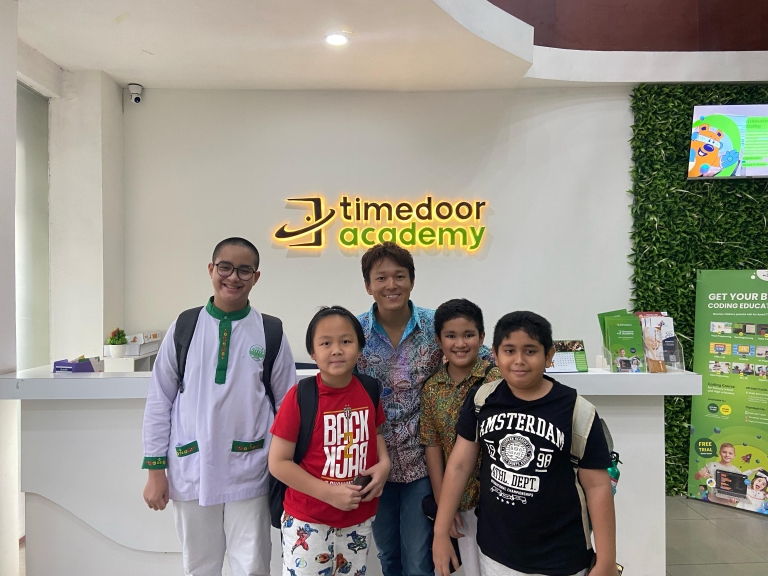
Our Timedoor Academy , a STEM school, has become a popular institution with 40 locations across Indonesia.
6. Music & Arts (Les Musik/Seni)
① Popular Activities
Piano, guitar, violin, ballet, dance.
Active music competitions (e.g., Yamaha Music Festival).
② Popular Music Schools
Yamaha Music School : Japanese-origin music education. Focuses on piano and guitar.
Purwacaraka Music Studio : Indonesia’s largest music school.
7. Sports (Les Olahraga)
① Popular Sports
Soccer (club academies like PSM Makassar, Persija).
Badminton (prestigious clubs like PB Djarum).
Taekwondo, judo, karate (training juniors for international competitions).
8. Costs of Tutoring and Extracurricular Activities
Tutoring and extracurricular costs vary by type and city.
Public School Tutoring (Bimbel)
500,000 – 2,000,000
Private Exam Prep (Bimbel Ujian)
1,500,000 – 5,000,000
English Courses (EF, LIA)
1,000,000 – 4,000,000
Math Tutoring (Kumon, Sempoa)
700,000 – 2,500,000
Programming & STEAM
2,000,000 – 6,000,000
Music & Arts (Piano, Ballet)
800,000 – 3,500,000
Sports (Soccer, Badminton)
1,000,000 – 4,500,000
9. Characteristics of Indonesia’s Tutoring and Extracurricular Culture
✅ Advantages
High demand for tutoring due to intense competition in exams.
Importance of English education, leading to the spread of bilingual education.
Rapid growth in STEAM education (programming, robotics).
Abundant options for extracurricular activities like sports and music.
❌ Disadvantages
Disparities in educational opportunities between urban (Jakarta, Surabaya) and rural areas.
High costs of extracurricular activities, which are a burden for low-income families.
The need for tutoring due to the low quality of public school education.
Comparison of the Education Systems in Indonesia and Japan
The education systems of Indonesia and Japan share several similarities. However, there are also significant differences in areas such as compulsory education duration, curriculum content, enrollment rates, examination systems, and types of schools. This article provides a comprehensive comparison of the education systems in Indonesia and Japan, helping readers better understand how each system works.
1. Basic Structure of the Education System
Overview of the Education Systems in Indonesia and Japan
Aspect
Indonesia
Japan
Compulsory Education
9 years (6 years elementary + 3 years junior high)
9 years (6 years elementary + 3 years junior high)
Education Structure
6-3-3-4 system
6-3-3-4 system
Academic Year
Two semesters (July–December, January–June)
Two or three semesters (April–March)
School Hours
7:00–13:00 (public) / 7:00–15:00 (private & national plus)
8:30–15:30
Core Subjects
Indonesian, Math, Science, Social Studies, Religion, PE, English
Japanese, Math, Science, Social Studies, English, PE, Music, Art, Technology
English Education
Optional in elementary school, compulsory from junior high
Compulsory from Grade 5, intensified in junior & senior high
Examination System
National Exam (UN) abolished, replaced by school-based assessment (USBN)
High school entrance exams and university entrance exams
2. Comparison of Compulsory Education (Elementary & Junior High School)
2.1 Duration of Compulsory Education
Indonesia: 9 years (6 years of SD + 3 years of SMP)
Japan: 9 years (6 years of elementary school + 3 years of junior high school)
Although the duration is the same, school enrollment rates in Indonesia are lower in certain regions, especially among low-income families, where some students do not complete elementary school.
2.2 Elementary School (Sekolah Dasar / SD)
Aspect
Indonesia
Japan
Age Range
6–12 years (6 years)
6–12 years (6 years)
School Hours
7:00–12:00 (public), 7:00–15:00 (private)
8:30–15:00
Subjects
Indonesian, Math, Science, Social Studies, Religion, English (optional)
Japanese, Math, Science, Social Studies, English, Music, Art, PE
Around 40% (over 50% in cities, under 20% in rural areas)
Around 60%
Entrance Exams
National exam (SNBT) + university-specific exams
National Center Test + individual exams
4. Comparison of Types of Schools
School Type
Indonesia
Japan
Public Schools
Free or low-cost, quality varies by region
Operated by local governments, relatively uniform quality
Private Schools
Higher tuition, generally higher quality
Some elite schools, but less disparity with public schools
National Plus Schools
Bilingual education (English & Indonesian)
No direct equivalent
International Schools
For expatriates & affluent families, IB or Cambridge curriculum
Limited number of international schools
5. Comparison of Educational Challenges
Issue
Indonesia
Japan
Regional Disparities
Significant gap between urban and rural areas
Public education quality is relatively uniform
English Education
Weak in public schools, strong in national plus & international schools
Improving, but speaking skills remain a challenge
University Competitiveness
Low global rankings
Top universities like the University of Tokyo and Kyoto University rank highly
Structure of Indonesia’s Ministry of Education and Its Relationship with Local Governments
Indonesia’s education administration is managed through close coordination between the central government (the Ministry of Education) and local governments (provincial, regency, and city education offices). Under the policy of decentralization, local governments play a major role—especially in the management of primary and secondary education.
1. Structure of Indonesia’s Ministry of Education
Indonesia’s education system is overseen by two main ministries:
The Ministry of Education, Culture, Research, and Technology (Kemendikbudristek)
The Ministry of Religious Affairs (Kementerian Agama / Kemenag)
1.1 Ministry of Education, Culture, Research, and Technology (Kemendikbudristek)
Official Name: 📌 Ministry of Education, Culture, Research, and Technology
Main Responsibilities:
Developing curricula for early childhood education (PAUD), elementary (SD), junior high (SMP), and senior high schools (SMA/SMK)
Formulating national education policies
Managing teacher certification and professional development
Organizing national standardized examinations (SNBT, UTBK)
Supervising higher education institutions (universities and polytechnics)
Key Directorates:
Directorate
Role
Directorate General of Early Childhood, Primary, and Secondary Education (Ditjen PAUD, Dikdas, dan Dikmen)
Education policy from kindergarten to high school
Directorate General of Vocational Education (Ditjen Pendidikan Vokasi)
Management of vocational high schools (SMK) and skills training
Directorate General of Higher Education, Research, and Technology (Ditjen Dikti Ristek)
Supervision of universities and research institutions
Directorate General of Culture (Ditjen Kebudayaan)
Cultural education and preservation of traditional culture
Agency for Standards, Curriculum, and Educational Assessment
Teacher qualifications, training, and evaluation
Government Restructuring (October 2024)
Following the launch of President Prabowo’s new cabinet in October 2024, Indonesia’s education-related ministries were restructured into three separate ministries:
Ministry of Primary and Secondary Education Responsible for education from elementary to senior high school, including national standards, curriculum development, and teacher training.
Ministry of Higher Education, Science, and Technology Oversees universities and higher education institutions while promoting scientific research and technological innovation.
Ministry of Vocational Education and Training Focuses on vocational education and technical skills training aligned with labor market needs.
This restructuring aims to enable more specialized policymaking, improve efficiency, and enhance overall education quality and effectiveness.
1.2 Ministry of Religious Affairs (Kementerian Agama / Kemenag)
📌 The Ministry of Religious Affairs is responsible for managing religious education.
Main Responsibilities:
Administration of Islamic schools (Madrasah: MI, MTs, MA)
Supervision of Pesantren (Islamic boarding schools)
Certification of Islamic religion teachers
Management of Hajj and Umrah pilgrimages
School Administration by Ministry
Type of School
Supervising Authority
General schools (SD, SMP, SMA, SMK)
Ministry of Education
Islamic schools (Madrasah: MI, MTs, MA)
Ministry of Religious Affairs
Pesantren (Islamic boarding schools)
Ministry of Religious Affairs
2. Relationship with Local Governments
Since the enactment of the Regional Autonomy Law (Otonomi Daerah) in 1999, a significant portion of education management has been decentralized to local governments.
2.1 Structure of Local Education Authorities
Education administration operates at three levels: national, provincial, and regency/city levels, each with its own Education Office (Dinas Pendidikan).
Level
Authority
Main Responsibilities
Central Government
Ministry of Education
National policy, curriculum development, higher education
Provincial Government
Provincial Education Office
Management of senior high schools (SMA, SMK), teacher training
Regency / City Government
Regency/City Education Office
Management of PAUD, elementary (SD), and junior high schools (SMP)
Key Points:
Elementary and junior high schools (SD, SMP) are managed by regency/city governments.
Senior high schools (SMA, SMK) are managed by provincial governments.
Universities are managed by the central government.
3. Education Administration Process
3.1 Education Policy Decision Flow
The Ministry of Education formulates the national curriculum (Kurikulum Merdeka).
Provincial and local education offices provide guidance to schools.
Schools implement the curriculum based on local instructions.
Teachers participate in training programs organized by local governments.
3.2 Education Budget Allocation
The central government allocates 20% of the national budget (APBN) to education.
Funds are distributed to provinces and local governments through regional budgets (APBD).
Local governments provide School Operational Assistance (BOS) funds directly to schools.
What Is BOS (Bantuan Operasional Sekolah)?
Government funding to support free primary and junior secondary education.
Public schools use BOS funds to eliminate or reduce tuition fees.
4. Challenges and Future Outlook
4.1 Regional Disparities
Significant education gaps between urban and rural areas (e.g., Jakarta vs. Papua).
Differences in local government fiscal capacity lead to unequal school quality.
4.2 Improving Teacher Quality
Limited access to teacher training in rural areas.
Regional salary disparities cause teacher shortages outside major cities.
4.3 Promoting Digital Education
The “Merdeka Belajar” (Freedom to Learn) policy promotes online and distance learning.
Poor infrastructure in remote regions slows down digital transformation.
4.4 Corruption and Budget Management
Cases of misuse of education funds in certain local governments.
The Ministry of Education and the Corruption Eradication Commission (KPK) have strengthened monitoring efforts.
Summary
Indonesia’s education system is built on the National Education System Law (Undang-Undang Sistem Pendidikan Nasional) and follows a multi-layered structure, ranging from early childhood education (PAUD) to higher education (Pendidikan Tinggi). While the system is anchored in nine years of compulsory education, the government continues to promote reforms aimed at increasing upper secondary and higher education enrollment, expanding digital learning, and strengthening vocational education.
Despite these efforts, several challenges remain. Regional disparities in education quality, limited teacher training, aging school facilities, and misuse of education budgets due to corruption continue to hinder progress. Schools in rural and remote areas often lack adequate infrastructure, resulting in lower enrollment rates and academic performance compared to urban schools.
Through the “Merdeka Belajar” (Freedom to Learn) policy, the government seeks to increase flexibility in education and better address students’ individual needs. In addition, the expansion of scholarship programs such as KIP-K aims to improve access to education for students from low-income families.
Looking ahead, key priorities include stronger collaboration with industry, producing graduates with labor-market-relevant skills, improving school environments in rural regions, and ensuring transparent and effective use of education budgets. Indonesia’s education system continues to evolve, and sustained reform will be essential to developing the younger generation that will shape the nation’s future.
For business in Indonesia, choose Timedoor, celebrating its 10th anniversary.
System development, IT education services, Japanese language education and personnel dispatch services, business expansion support services.