April 15, 2025 • Berita • by Erika Okada
Why Marugame Udon Became So Successful in Indonesia: The Power of Local Adaptation
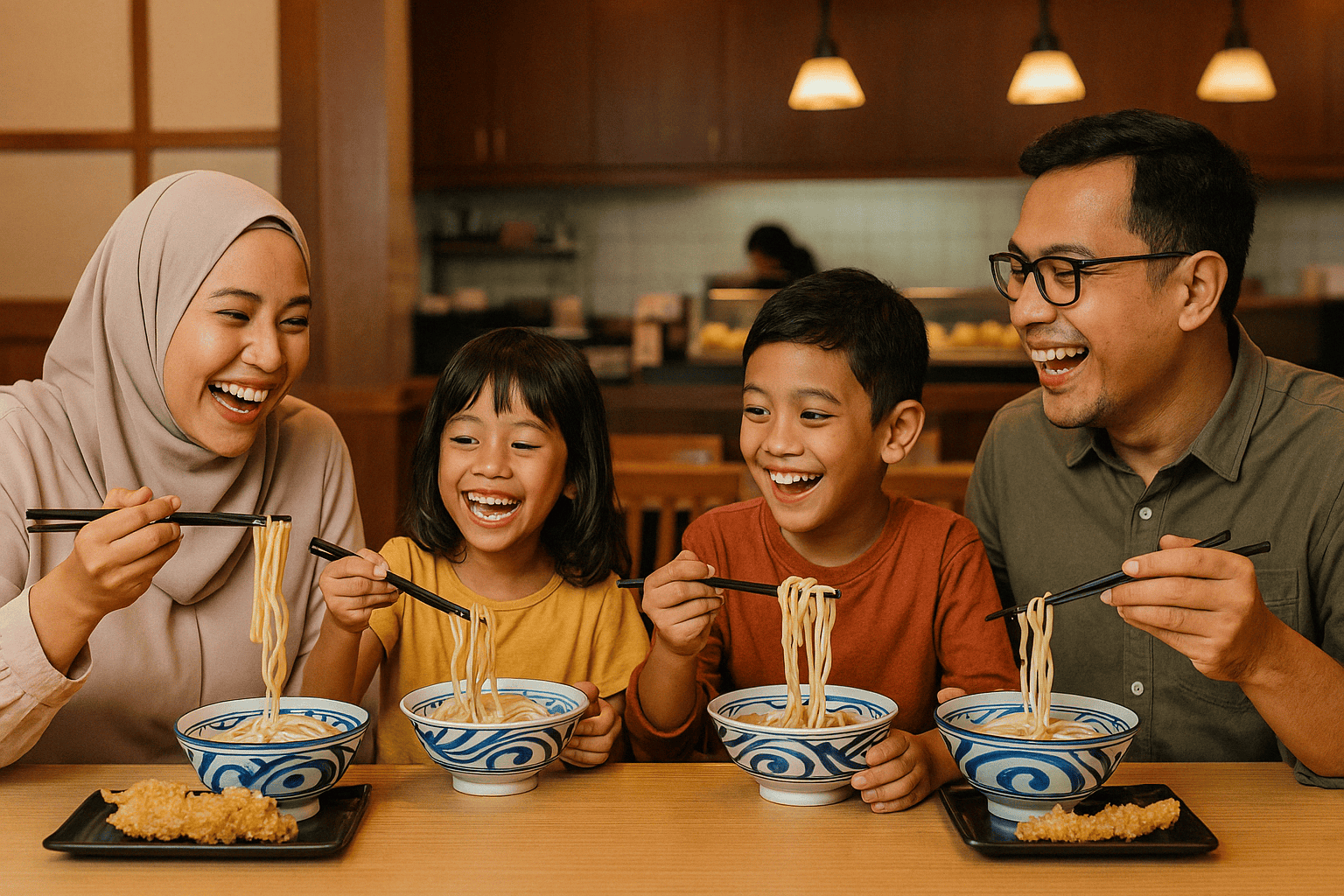
Table of Contents
The Sanuki udon chain Marugame Udon, originally from Japan, has achieved remarkable success in Indonesia. Since opening its first store in Jakarta in 2013, the brand has expanded rapidly, reaching 100 locations in just under a decade. Today, Marugame Udon operates across the country, having expanded beyond Java to major islands such as Bali, Sumatra, Kalimantan, and Sulawesi, becoming one of Indonesia’s most popular Japanese food brands.
Among the nine countries where Marugame Udon operates overseas, Indonesia stands out overwhelmingly. Nearly 40% of all its international stores are concentrated in Indonesia, making it by far the company’s largest overseas market. Not only in Japan but globally, it is extremely rare for a Japanese restaurant chain to scale this quickly abroad. As a result, many observers have become interested in understanding the factors behind this success.
At the time of entry, there were doubts about whether Indonesians—who were not traditionally familiar with udon—would embrace the concept. However, Indonesia already had a strong noodle culture and a generally positive perception of Japan. Combined with a population of approximately 280 million and the rapid expansion of the middle class driven by economic growth, Indonesia represented a highly attractive opportunity for Marugame Udon.
This article explores why Marugame Udon succeeded in the Indonesian market, focusing on its local initiatives and strategic decisions. To ensure clarity for business readers in Japan, Europe, and North America who may be unfamiliar with Indonesia, the article also explains relevant cultural and market background, organizing key points in a structured and accessible way.
Deep Localization and Adaptation to the Indonesian Market
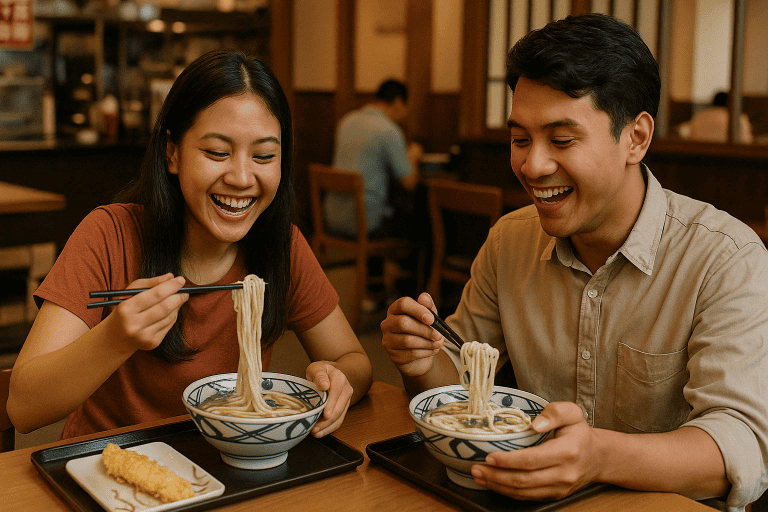
The key to success in Indonesia was Marugame Udon’s commitment to localization. Rather than simply exporting its Japanese business model, the company flexibly adapted its operations to Indonesia’s culture, religion, and food habits. This localization strategy allowed the brand to remain authentically Japanese while becoming genuinely embraced by local consumers.
Halal Compliance and Respect for Religious Culture
First and foremost, halal compliance was essential. Indonesia is the world’s largest Muslim-majority country, with approximately 87% of the population identifying as Muslim. For food service businesses, avoiding pork and alcohol and obtaining halal certification are critical requirements.
Marugame Udon responded early by securing official halal certification. Ingredients commonly used in Japan—such as soup stock or seasonings containing pork-derived elements—were eliminated. Instead, stores prepared broth using chicken bones and halal-approved ingredients. In 2015, the company was officially recognized by Indonesian authorities as a halal-certified restaurant operator, ensuring that Muslim customers could dine with confidence.
This religious consideration also became a powerful marketing asset. On its official Indonesian Instagram account, Marugame Udon clearly states its halal certification in the profile description. For Indonesian consumers, this reassurance significantly lowers the barrier to trying unfamiliar foreign cuisine. Some larger outlets even provide on-site prayer rooms (musholla), demonstrating attention to local religious practices beyond food alone.
Adapting to Local Food Culture and Taste Preferences
Indonesia already has a deeply rooted noodle culture, with dishes such as mie goreng (fried noodles), bakmi (noodle soup), and kwetiau (rice noodles). While Japanese udon differs in texture, the familiarity with noodle-based meals created a receptive environment.
That said, Marugame Udon did not assume Japanese flavors would be accepted unchanged. The company adjusted its udon to better match local preferences. While Japanese consumers favor firm, chewy noodles, Indonesians tend to prefer a smoother mouthfeel. As a result, noodles in Indonesia are made slightly softer, thinner, and shorter—about 45 cm rather than the standard 60 cm in Japan—making them easier to eat.
Spice tolerance was another major consideration. Indonesian cuisine heavily features chili and spices, so Marugame Udon added fresh chopped red chili as a self-serve topping alongside traditional condiments like green onions and tempura flakes. This allowed customers to customize the heat level, helping udon feel more familiar and personal.
Localized Store Experience: Design and Service
Success in food service depends not only on taste but also on the in-store experience. Marugame Udon localized both its interior design and service style.
Initially, Japanese restaurants in Indonesia were often perceived as expensive and formal. To build trust, Marugame Udon designed interiors that felt authentically Japanese yet refined, incorporating elements such as roof-tile-inspired décor, traditional Japanese patterns, cherry blossom motifs, and muted gray tones with indirect lighting.
Over time, feedback from customers—especially younger audiences—led to brighter, more casual designs. Stores evolved to feel more open, clean, and “Instagrammable.” This shift proved effective, as stylish interior photos shared on social media became a powerful form of organic promotion.
The brand also introduced Japan-style live cooking. Customers can watch staff boil noodles and prepare dishes in an open kitchen, creating a sense of freshness, transparency, and entertainment. This combination of Japanese craftsmanship and locally appealing ambiance became a strong differentiator.
Menu Strategy Tailored to Local Tastes
Perhaps the most striking aspect of Marugame Udon Indonesia is its menu localization. Compared to Japan, the lineup is dramatically different, reflecting aggressive local product development.
Bestselling Items Unique to Indonesia
Classic items like kake udon or kitsune udon play a minor role. Instead, beef-based and curry-based udon dominate sales. The top-selling dish is beef udon topped with sweet-savory seasoned beef, followed by beef curry udon and chicken katsu curry udon—items not found in Japan.
Western-inspired dishes such as seafood tomato udon and beef carbonara udon further demonstrate the brand’s flexibility. While unconventional from a Japanese perspective, these flavors align well with Indonesia’s exposure to pasta dishes.
At the same time, traditional udon options remain available, subtly adjusted in seasoning to suit local tastes. This balance—authentic foundations paired with bold localization—proved highly effective.
Side Dishes, Desserts, and Bento Sets
Side menus were also adapted. Tempura remains self-serve, but with localized twists. A standout example is nori tempura topped with chili powder and mayonnaise, now one of the most popular items. Deep-fried dishes resonate strongly with Indonesian preferences, driving higher average order value than in Japan.
Desserts such as pudding and jelly—absent in Japanese stores—are offered near the register, allowing customers to complete an entire meal in one place.
Additionally, Indonesia introduced bento-style set meals, combining udon with rice bowls. These high-volume sets appeal to lunch customers seeking both convenience and fullness, helping Marugame Udon move beyond a “noodle-only” identity.
Product development is largely led by local Indonesian teams, with headquarters providing quality oversight rather than micromanagement. This autonomy has resulted in innovations such as halal-friendly chicken paitan udon and dishes inspired by traditional Indonesian cuisine. Consistent recipes across stores ensure reliability and trust.
Strategic Marketing and Promotion
To establish a strong local presence, offering good products alone is not enough—effective marketing and brand communication are essential. Marugame Udon Indonesia has consistently invested in promotional and branding strategies aligned with digital-era consumer behavior, successfully increasing brand awareness and market penetration.
Digital Strategy Leveraging Social Media and Food Delivery Platforms
Indonesia is known for its exceptionally high usage of social media platforms such as Facebook and Instagram. Especially among younger consumers, social media functions as a primary source of daily information. Recognizing this, Marugame Udon actively utilizes its official social media accounts to engage with customers.
As mentioned earlier, communicating halal certification is one key aspect of this strategy. Beyond that, the brand regularly shares information about limited-time menu items, promotional campaigns, and store updates, while also encouraging two-way communication with followers.
On Instagram, Marugame Udon posts visually appealing food photography and interior shots, while using Stories features such as quizzes and polls to boost engagement. The brand has also integrated a “Order Food” button on its Instagram profile, allowing users to seamlessly transition to the GoFood delivery platform with a single tap.
On-demand delivery services such as GoFood (by Gojek) and GrabFood have seen explosive growth in Indonesia’s urban areas. By integrating these platforms into its social media funnel, Marugame Udon effectively converts casual browsing into purchases and highlights the convenience of online ordering.
In addition, the company actively collaborates with local influencers. Popular food bloggers on Instagram and YouTube are invited to visit stores and share tasting experiences through reviews and videos. In Indonesia, influencer marketing carries significant weight—particularly among younger demographics—and has proven highly effective for brand discovery. By skillfully combining social media advertising and influencer-driven promotions, Marugame Udon successfully built a positive brand image as “affordable and delicious Japanese udon.”
Local Campaigns and Seasonal Promotions
Offline promotions have also played an important role in attracting customers. During new store openings, Marugame Udon frequently offers limited giveaways or discount coupons for early visitors, intentionally creating long lines to generate buzz and social media exposure.
The brand also runs special campaigns to mark key milestones. In October 2023, when Marugame Udon reached its 100th store in Indonesia, it launched a limited-time promotional set called “Hemat Berdua 100K”—a value meal for two priced at IDR 100,000. Featuring popular items such as beef udon and chicken katsu curry udon, the promotion encouraged visits from friends and families alike. These milestone-based offers not only motivate loyal customers to return but also spark curiosity among new customers drawn by the sense of excitement.
Seasonal and religious events are another critical focus. Indonesia observes major Islamic occasions such as Ramadan and Lebaran (Eid al-Fitr), during which evening dining demand increases significantly. During Ramadan, Marugame Udon offers iftar (breaking fast) meal sets timed for sunset and promotes menu combinations suitable for group sharing.
The brand also adapts to national holidays and celebrations such as Christmas and Independence Day, introducing limited-time menu items (e.g., special tempura assortments) and festive in-store decorations. By aligning its promotions with local cultural moments, Marugame Udon has successfully cultivated repeat customer behavior—reinforcing the habit of choosing Marugame Udon for meals during special occasions.
Brand Concept: Authentic Japanese Quality That Feels Approachable
At the core of its marketing efforts in Indonesia, Marugame Udon established a clear and simple brand idea: authentic Japanese udon that is easy to enjoy every day.
The brand emphasizes that its udon is genuinely Japanese—made fresh in-store using traditional methods—while avoiding the image of being expensive or exclusive. Instead, Marugame Udon positions itself as a casual restaurant for everyday meals, not a special-occasion destination. This balance between authenticity and accessibility is consistently reflected in its advertising and media messaging.
In interviews with local media, Marugame Udon Indonesia’s management has explained that the brand aims to be “a casual Japanese restaurant that offers healthy and delicious udon as part of daily life.” To support this message, the company actively communicates its focus on quality, such as using natural ingredients without preservatives and preparing noodles fresh in each store. These efforts help build an image of food that is both tasty and wholesome.
At the same time, store expansion and pricing strategies reinforce the idea that Marugame Udon is affordable and familiar. This consistency makes the brand message easy to understand and trust. Rather than linking high quality with high prices, Marugame Udon promotes the idea that good food should be accessible through efficient operations. This mindset has resonated strongly with Indonesian consumers.
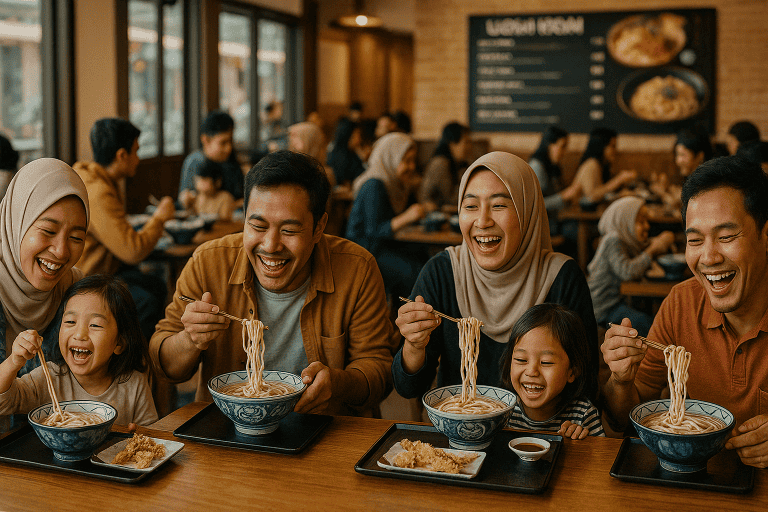
Family appeal also plays a major role in the brand strategy. In Indonesia, eating out is often a family activity, and gaining support from families is essential for chain restaurants. Marugame Udon designed its stores with flexible seating and long tables for large groups, and introduced child-friendly menu options such as mild udon and fried chicken.
By consistently communicating that families are welcome, Marugame Udon has successfully positioned itself as a Japanese restaurant that everyone—from children to adults—can enjoy together.
Pricing Strategy Matched to Local Purchasing Power
Even the best food and store design cannot sustain customer traffic if prices feel out of reach. In Indonesia, Marugame Udon has built a strong reputation as a high-value Japanese restaurant by carefully matching prices to local income levels.
The Power of “Affordable Japanese Food”
In Indonesia, Japanese restaurants have traditionally been associated with high prices. Sushi, yakiniku, and shabu-shabu restaurants often target affluent customers and expatriates, creating the widespread perception that Japanese food is expensive.
Marugame Udon challenged this image by offering authentic Japanese udon at prices similar to fast-food restaurants. Most dishes are priced between IDR 30,000 and 50,000 per bowl, which is affordable for middle-class consumers dining in shopping malls. This pricing makes Marugame Udon comparable to gyudon chains or burger restaurants, rather than premium Japanese dining.
Importantly, this affordability does not come from cutting corners. Customers still experience freshly made noodles, open-kitchen cooking, and carefully prepared tempura. For many diners, this leads to a positive surprise: “The quality is much better than the price suggests.” As a result, customers who might normally avoid Japanese food due to cost are more willing to try it—and often return.
How Marugame Udon Keeps Prices Low Without Sacrificing Quality
Marugame Udon’s pricing strategy is supported by several operational advantages.
First, the company does not rely on a central factory or kitchen. Instead, each store is equipped to make noodles on-site. This reduces the need for large upfront investments and makes it easier to open new stores at lower cost.
Second, Marugame Udon sources most ingredients locally. Indonesia produces wheat flour, cooking oil, chicken, and vegetables domestically. With the support of a local flour manufacturing partner, the brand is able to procure key ingredients within the country. Only a small number of items essential to Japanese flavor—such as kombu, bonito flakes, and nori—are imported. This approach reduces currency risk, transportation costs, and import taxes.
Third, rapid expansion has created economies of scale. By growing to more than 100 stores nationwide, Marugame Udon gained stronger bargaining power with suppliers and improved logistics efficiency. This scale advantage allows the brand to maintain competitive prices that smaller restaurants cannot easily match.
Competing on Value, Not Just Price
Indonesia’s food service market includes many price tiers, from street food costing just a few dollars to premium restaurants charging over USD 20 per meal. Marugame Udon deliberately positioned itself between fast food and casual family restaurants.
Rather than competing with the cheapest options, the brand focused on delivering reliable quality at a fair price. Entering the lowest price segment would have required lowering standards, which could damage the credibility of a Japanese brand. By avoiding a “cheap but low-quality” image, Marugame Udon earned customer trust.
At the same time, the company uses set menus and limited-time promotions to create a sense of added value. Customers come to feel that Marugame Udon is consistently affordable—and sometimes even better value during campaigns. Over time, this approach has helped build long-term loyalty, making customers more understanding of small price adjustments when costs rise.
Talent Management and Local Organizational Strategy
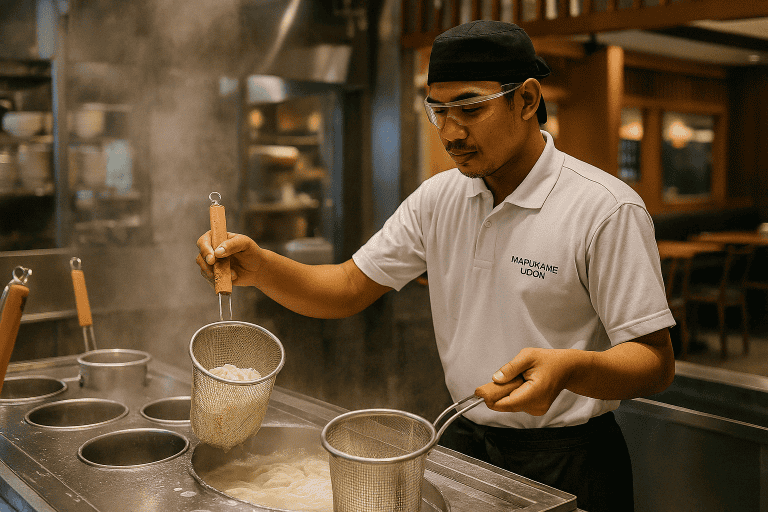
Finally, let’s look at the people and organizational strategies behind Marugame Udon Indonesia’s success. Beyond products and marketing, the brand’s growth has been strongly supported by the people who run the business on the ground—local staff, leadership teams, and strategic partners. This section explores how Marugame Udon built an effective collaboration model between Japan and Indonesia, while empowering local talent.
Partnering with a Strong Local Company
One of the most important decisions Marugame Udon made when entering Indonesia was the selection of its local partner. In overseas expansion, working with a partner that deeply understands the local market can significantly reduce risk and improve the chances of success.
Rather than relying on a standard franchise model, Toridoll Holdings—the operator of Marugame Udon—actively seeks what it calls “local buddies”: long-term strategic partners who share the same vision. In Indonesia, Toridoll partnered with the Sriboga Raturaya Group, a leading flour manufacturer, and established a joint venture called PT Sriboga Marugame Indonesia (PT SMI) in 2013.
Sriboga was an ideal partner for two key reasons. First, it is one of Indonesia’s largest flour producers, ensuring a stable supply of Marugame Udon’s most important ingredient. Second, the group has extensive experience operating more than 200 Pizza Hut franchise stores nationwide, giving it strong expertise in multi-store restaurant management.
This partnership allowed Marugame Udon to secure reliable ingredient sourcing and build a nationwide store network more quickly. By lowering the barriers related to initial investment and operational know-how, the brand was able to establish itself smoothly in the Indonesian market.
Importantly, the relationship went beyond short-term business interests. Toridoll’s vision—to deliver inspiring food experiences around the world—was shared by Sriboga, which committed to long-term brand development. Regular management meetings and close communication between headquarters in Japan and the local team helped both sides move forward as true partners. This trust-based collaboration played a critical role in supporting the brand’s growth to over 100 stores within a decade.
Hiring, Training, and Empowering Local Staff
At the store level, local staff are the backbone of operations. In Marugame Udon Indonesia, the vast majority of employees—from kitchen staff to store managers—are Indonesian. During the early expansion phase, Japanese trainers and a small number of Japanese managers were dispatched to transfer know-how. However, their role was intentionally temporary.
From an early stage, authority and responsibility were gradually delegated to local employees. Today, most stores are run autonomously by Indonesian managers, while only a small number of Japanese staff remain in overarching supervisory roles.
Recruitment focuses on young people with service experience or an interest in Japanese food. Through in-house training, staff learn noodle-making, tempura preparation, hygiene standards, and Japanese-style hospitality. Emphasis is placed on basics such as cleanliness, greetings, and friendly service—key elements of Japanese restaurant culture.
At the same time, Marugame Udon encourages local initiative and feedback. Employees are invited to share ideas in their own language, including suggestions such as preferred flavors in certain regions or more efficient operations during specific time slots. These insights are reflected in menu improvements and service adjustments. By respecting local voices, the company boosts employee motivation, which in turn improves customer satisfaction.
There is also a notable example of a local marketing staff member who worked for ten years to grow the brand from near-zero awareness to nationwide recognition. This story highlights Marugame Udon’s culture of trusting local talent and fairly recognizing contributions. By appointing Indonesians to key roles—such as product development leaders and area managers—the company maintains speed, cultural sensitivity, and market awareness.
The Role of Japanese Leadership and Cross-Cultural Management
For many years, the top leadership role in Indonesia was held by CEO Hajime Kondo, who was dispatched from Japan. Having overseen Toridoll’s overseas business, Kondo relocated to Indonesia from the early stages of expansion. His mission was to connect the vision of headquarters with local execution, while creating an environment where the Indonesian team could perform at its best.
Kondo demonstrated deep respect for Indonesian culture and religion, and made a conscious effort to build trust with local staff. He reportedly learned the local language, participated in employees’ family events, and showed sensitivity to Islamic customs in both his leadership style and daily life. This approach fostered a culture of mutual respect rather than rigid top-down control.
In daily decision-making, Kondo also acted as a bridge between Japan and Indonesia. He balanced Japan’s strict quality standards with local realities, carefully deciding how far localization should go. Guided by his belief that “true success overseas requires full localization,” he made bold decisions that ultimately paid off.
This approach clearly differentiated Marugame Udon from competitors that struggled overseas. While some Japanese udon chains failed to adapt and withdrew from international markets, Marugame Udon expanded its menu with beef, chicken, and curry-based options to suit local tastes. This flexibility proved decisive in Indonesia.
Sadly, Kondo passed away in 2024 after a five-year battle with cancer. His dedication to Indonesia and his lifelong mission to share Japanese udon culture left a lasting legacy. With the deepest respect for his contributions, his leadership remains an integral part of Marugame Udon Indonesia’s success story.
Conclusion
Marugame Udon’s success in Indonesia goes far beyond simply offering Japanese food. The key lies in its deep adaptation to the local market—including culture, religion, eating habits, and consumer behavior. From halal compliance and localized flavors to thoughtful store design, every element was carefully adjusted for Indonesian customers. These efforts were reinforced by effective digital marketing, including influencer partnerships and active use of social media.
Equally important was the company’s locally driven business model. By working closely with a strong local partner and placing Indonesian staff at the center of daily operations, Marugame Udon built an organization that could respond quickly to market needs. The leadership of the late CEO Hajime Kondo, along with his flexible and culturally sensitive decision-making, played a crucial role in earning trust and building long-term brand loyalty.
Marugame Udon’s journey in Indonesia offers a valuable case study for Japanese companies expanding into overseas markets. It demonstrates that sustainable success in cross-cultural environments depends not on exporting a model unchanged, but on respecting local realities, empowering local teams, and committing fully to localization.
For business in Indonesia, choose Timedoor, celebrating its 10th anniversary.
System development, IT education services, Japanese language education and personnel dispatch services, business expansion support services.
Contact Us.

Looking for E-commerce MobileApp for your Retail business? Learn more on APPMU
Glossary of Key Terms Used in This Article
Halal
A term in Islamic law that refers to what is permitted. In food, halal means that ingredients do not contain pork or alcohol and are prepared according to Islamic guidelines and approved procedures.
Localization
The process of adapting products or services to fit the local culture and market. This can include changes in flavor, language, design, menu structure, and customer experience.
“Instagrammable”
Content or visuals that look attractive on social media platforms such as Instagram and are easy to share. This concept is often used in store design and menu presentation to appeal to younger audiences.
Buka Puasa
The meal eaten after sunset to break the fast during Ramadan. For restaurants, this period represents an important opportunity for increased evening sales.
Central Kitchen
A centralized facility where food is processed or prepared in bulk to improve efficiency and maintain quality. Marugame Udon does not use this model, choosing instead to prepare food fresh in each store.
Local Sourcing
The practice of procuring ingredients or products directly from local suppliers or producers in the target market. This approach helps reduce costs, improve supply stability, and support local economies.
Frequently Asked Questions (FAQ)
Q1. Why was Marugame Udon so successful in Indonesia?
A: Because the brand fully adapted to the Indonesian market. This included halal compliance, localized flavors, strong partnerships with local companies, effective social media marketing, and a carefully designed in-store experience.
Q2. Are the menus in Japan and Indonesia the same?
A: No. In Indonesia, Marugame Udon focuses on beef- and curry-based dishes with bolder flavors and larger portions. Many menu items are developed specifically for local preferences and differ significantly from those in Japan.
Q3. Why is halal certification so important?
A: Indonesia has the world’s largest Muslim population. Halal certification builds trust and assures customers that the food meets Islamic standards, making it a key factor in attracting and retaining customers.
Q4. How did Marugame Udon change the image that “Japanese food is expensive”?
A: By preparing food in-store, sourcing ingredients locally, and leveraging economies of scale. These measures allowed the brand to maintain high quality while offering affordable prices.
Q5. What was Hajime Kondo’s role in Marugame Udon Indonesia?
A: He was appointed from Toridoll as the local CEO and led both strategy and execution. Through deep cultural understanding and strong localization, he guided the brand’s expansion to over 100 stores in ten years.